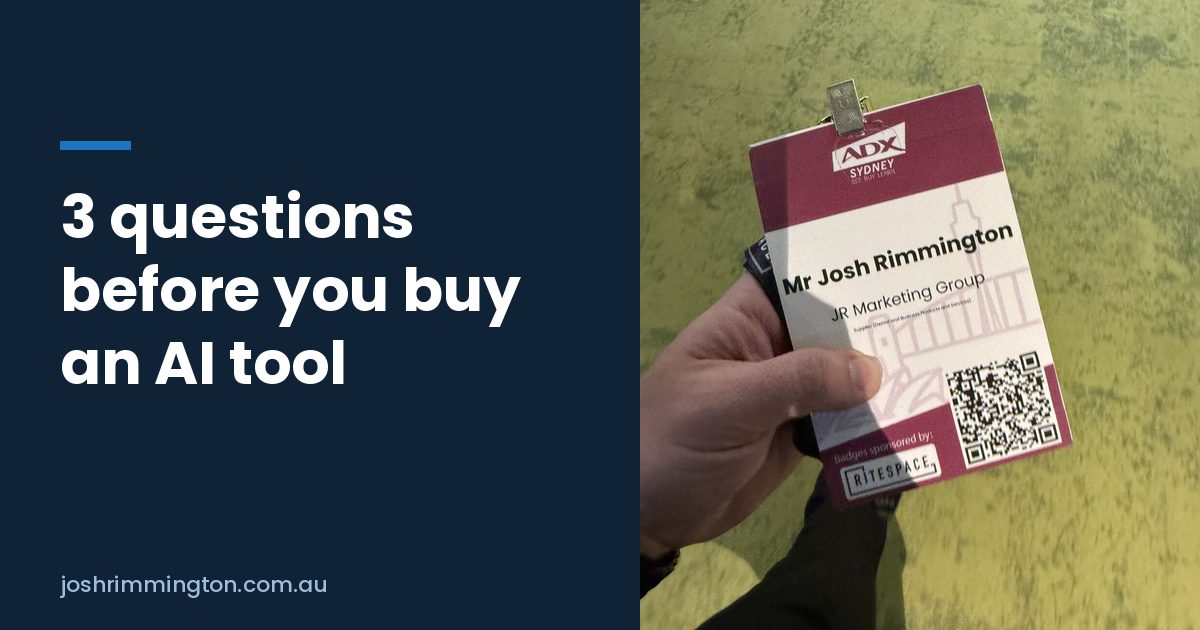
I’d just got back from ADX Sydney, one of the best dental expos in the country. As always, it was brilliant catching up with clients and meeting some genuinely great people in the industry.
But I couldn’t help noticing a theme this year. AI had well and truly arrived at the party.
Booth after booth. Pitch after pitch. AI this, AI that.
I’m not here to bash AI
Let me be clear up front. I studied AI and digital transformation at Stanford Business School. I use AI every single day in my agency. I genuinely believe it’s one of the most powerful tools available to business owners right now.
But here’s what I also saw walking around that expo: a lot of businesses using AI simply because they can.
Some of what I came across looked genuinely impressive. Some of it, I honestly couldn’t figure out what problem it was solving. And some of it? I’m pretty sure the problem doesn’t even exist.
The shiny object problem
If you run a business, you’ll know the feeling. A new tool lands in your inbox. The demo looks amazing. Everyone’s talking about it. You start to worry that if you don’t jump on it, you’ll get left behind.
That fear is exactly what a lot of AI marketing is built on right now. And it’s how business owners end up paying for a stack of subscriptions they barely use, or spending weeks setting up something that doesn’t actually change anything.
Three questions to ask before you buy
So before you jump on the next AI tool, ask yourself a few honest questions.
1. Is it actually helping me generate more revenue?
Will this bring in more customers, help me convert more of the enquiries I already get, or help me sell more to the customers I already have? If you can draw a clear line from the tool to more money coming in, that’s a good sign.
2. Is it speeding up a process that was slowing me down?
Think about the jobs in your business that eat up time: admin, scheduling, reporting, writing first drafts, answering the same questions over and over. If a tool takes one of those and makes it genuinely faster, it’s earning its keep.
3. Is it removing the need to hire an extra person?
Sometimes the right tool means you can grow without adding to your wage bill straight away. That’s a real benefit, especially for small businesses where every hire is a big decision.
If you can’t answer yes to at least one of those, it might just be a shiny object pulling your attention away from what actually moves the needle in your business.
Start with the problem, not the tool
The best way I’ve found to approach AI is to work backwards. Don’t start with “what AI should we use?” Start with “what’s slowing us down?” or “where are we losing customers?” Then look for a tool that fixes that specific thing.
That approach saves a lot of money, and a lot of headaches. It also means that when you do bring in a new tool, your team understands why it’s there.
A note for dental practices
Because ADX is a dental expo, I’ve got to mention this. In a dental practice, any AI tool also has to respect patient privacy and compliance. A tool that saves time but puts patient information at risk isn’t a good deal. Check how it handles data before you sign up.
Focus is more powerful
AI is powerful. But focus is more powerful. Don’t lose one chasing the other.
Use AI where it helps you make money, save time or grow without the extra cost. Ignore the rest, at least for now. The tools will keep coming. Your attention is the thing that’s actually limited.
Not sure where AI fits in your business?
If you’d like a hand working out which AI tools are worth it for your business, and which ones you can skip, email me at Josh@jrmg.com.au or book a call.